
05 November 2026
Words: Héctor Silva Ávalos, reporting from Washington
Illustration: Jonathan Gómez
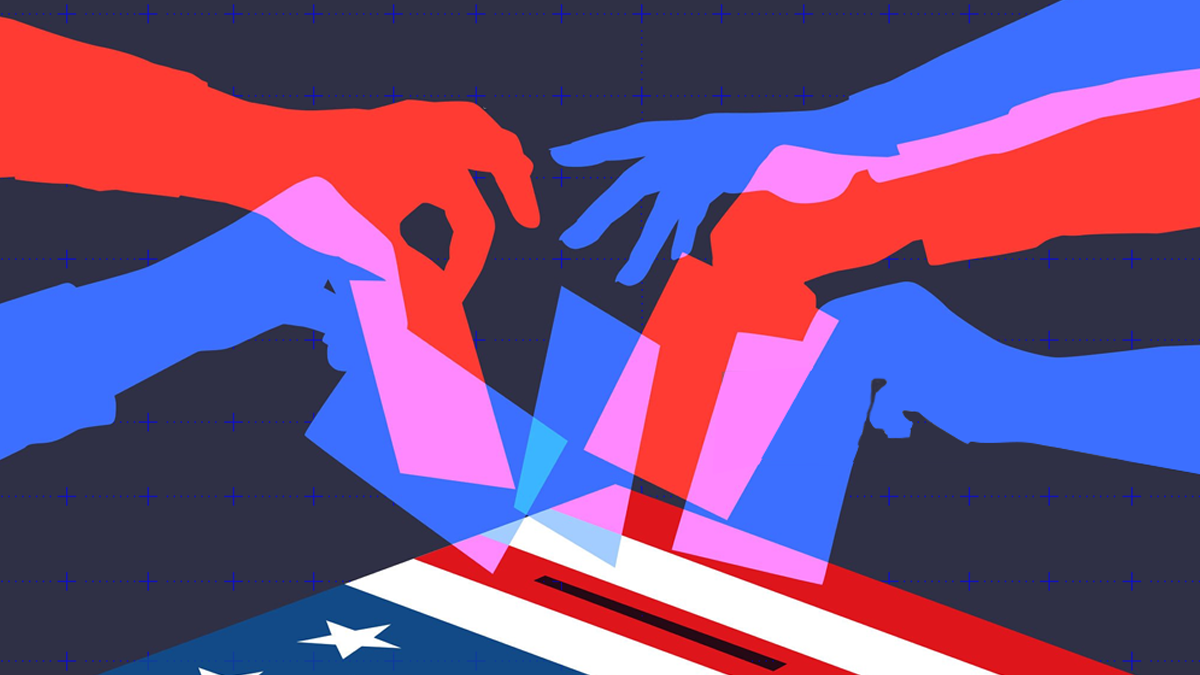
The Democratic Party secured control of both chambers of Congress, as well as a number of governorships in traditionally Republican strongholds, in this week’s US midterm elections. It marks a political shift that could have major implications for the country’s domestic and foreign policy, as well as for President Donald Trump’s agenda.
There were several historic firsts. Gina Hinojosa, a representative of the party’s progressive wing, will become the first Latina woman to govern Texas. Xavier Becerra, who is also of Latino heritage, will become governor of California. These are the two most populous states in the US. Keisha Lance Bottoms was elected Georgia’s first African-American woman governor. Georgia is one of the most historically significant centres of the civil rights movement.
Abdul El-Sayed, from Michigan and a representative of the Democratic Party’s progressive wing, became the first Muslim to enter the Senate.
The results reflect deep voter dissatisfaction with some of the government’s policies, particularly its failure to tackle the rising cost of living. Even a substantial proportion of the Latino community turned its back on Republican candidates, many of whom had supported them until recently, according to AP data.
But how could these results affect the struggle between political, economic and criminal powers in Latin America? We examine some of the key questions.
The new Congress is likely to reshape the final two years of the Trump administration.
Although foreign policy in the United States is determined by the executive branch, Congress has significant powers to influence and constrain it.
First, as the majority party, the Democrats will chair congressional committees and control the legislative agenda. This means they will be able to convene existing committees, establish new ones, summon government officials to testify and subject decisions made by the White House to scrutiny. The question now is how they will choose to exercise that power.
Second, there is the issue of the budget. Both the House of Representatives and the Senate play a role in approving federal spending, including funding for international cooperation programmes, military assistance, security initiatives and aid to other governments. This is a crucial tool in determining how public policies are implemented.
As far as foreign policy is concerned, Venezuela is likely to feature prominently on the agenda, particularly in relation to the oil deals Trump negotiated behind closed doors and the benefits they generated for his allies.
For countries that are not a foreign policy priority, such as those in Central America, Congress can set the tone, whether through opposition to, acceptance of or indifference towards the policies pursued by their governments. This could have negative consequences for leaders such as Nayib Bukele in El Salvador and Nasry Asfura in Honduras, who have pursued hard-line security policies with Trump’s approval, despite criticism that these measures violate human rights.
Furthermore, the possible expansion of investigations into the president and some of his closest allies, concerning questions about their business dealings and other matters, could distract Trump from his regional agenda.
The Trump administration has brought about a major shift in the way the United States tackles organised crime in Latin America. This has included designating criminal groups as ‘Foreign Terrorist Organisations’, broadening the scope of action available to the US against them, as well as militarising its regional security strategy, among other measures. In many cases, these strategies have had a profound impact on marginalised communities struggling to survive amid violence.
Since September 2025, US forces have carried out lethal military operations against vessels which the US government has accused of transporting drugs in the Caribbean and Pacific. At least 227 people were killed in 69 attacks carried out up to 2 September 2026, in what human rights organisations and the United Nations have already described as international crimes.
However, much of what is considered a protest vote against Trump stems from his decision to prioritise international issues rather than address key domestic concerns affecting his electorate. This could lead to a suspension or reduction in funding for these types of operations.
Since Trump’s return to the White House, the United States has stepped up deportations, restricted avenues for immigration protection and expanded agreements with Latin American governments to receive people deported from the US, including individuals who are not citizens of those countries.
Democrats will now face pressure to take decisions on these issues.
One option available to them is to try to restrict the budget of ICE (Immigration and Customs Enforcement), which would limit the agency’s operational capacity. But there is another dimension: the political one, which has to do with the Latino vote that all parties will be seeking to win ahead of the 2028 presidential election.
For this reason, and given what these election results have demonstrated, Republicans are likely to come under pressure to adopt a much less aggressive approach to immigration, partly to avoid losing the Latino vote altogether.
Some, however, argue that the opposite could happen: the results may embolden the most xenophobic elements of the White House, including Trump himself, prompting an even tougher stance on immigration.
When it comes to militarisation, budgetary considerations will be crucial, as will issues directly related to the Department of Defence, which is now referred to as the Department of War.
The war with Iran has taken a heavy toll on the country’s finances. It is a conflict that shows little sign of coming to a definitive end and continues to consume enormous resources. The conflict with Iran, immigration policy and inflation are among the factors that have contributed to Trump’s unpopularity.
All of this could therefore play an important role in determining how the strategy moves forward.
I believe that, in this respect, human mobility is a key issue, because what the Trump administration has done is criminalise it.
Historically, Democrats in the United States have been rather lukewarm and dismissive when it comes to immigration. But for a large part of the electorate, anything other than the current situation represents progress.
For most marginalised and criminalised communities in Latin America, however, the biggest problem is that they are simply not a priority for the United States.
It is therefore unlikely that Washington, whether under Republican or Democratic control, will take action in response to the abuses that figures such as Abelardo de la Espriella in Colombia, Javier Milei in Argentina or Nayib Bukele in El Salvador may commit — abuses that have a profound impact on marginalised communities. These issues simply do not appear to be on the agenda.
